Ashtanga Yoga: A Non-Heated Alternative to Hot Yoga
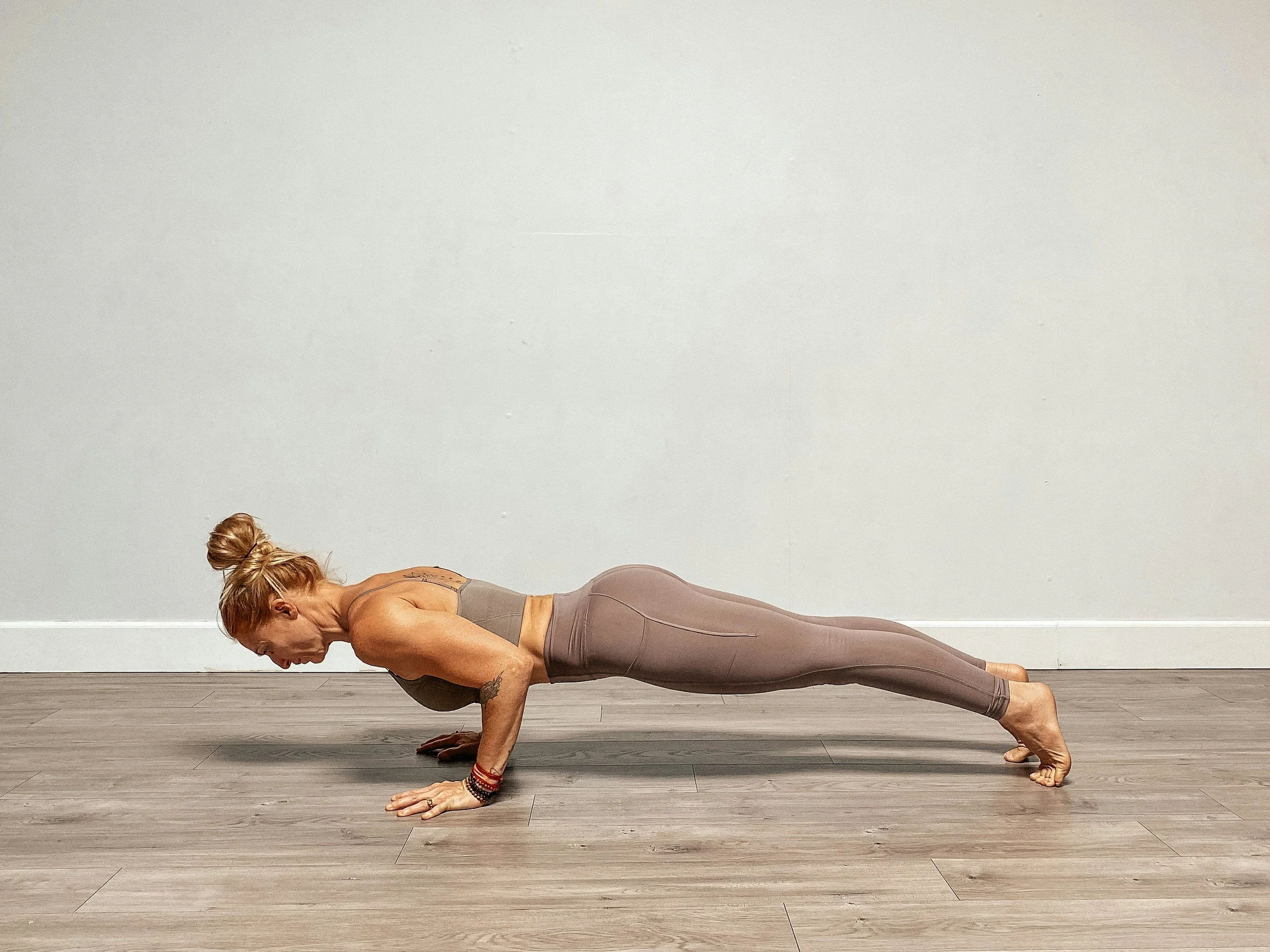
Woman in a plank position
For a long time, I believed the harder I worked at my health, the healthier I would become.
I trained for races, took multiple hot yoga classes a week, and treated exhaustion as evidence that I was doing something worthwhile. Meanwhile, my hair started falling out and my body was telling me that more intensity was not what it needed.
That experience helped shape the work I do now as a yoga therapist and it is part of why we offer Ashtanga at Sanctuary.
That may sound surprising. Ashtanga has a reputation for being rigid, advanced, and intensely physical. But when it is taught as an adaptable practice rather than a performance, it offers something very different: structure, repetition, focused attention, and the opportunity to build strength without adding heat, loud music, or pressure to keep up.
What is Ashtanga yoga?
Ashtanga is a traditional method of yoga in which postures are practiced in a consistent sequence and connected through breath and movement.
Because the sequence becomes familiar, you gradually spend less energy wondering what comes next. You can pay more attention to your breath, your body, and how you respond when something becomes challenging.
The sequence stays relatively consistent, so you get to observe what changes in you.
Is Ashtanga the same as hot yoga?
No. Ashtanga can be physically challenging, but it does not need to be practiced in a heated room.
At Sanctuary, Ashtanga is non-heated and taught without loud music or pressure to make your practice look like anyone else’s. The structure provides the challenge. We do not need to manufacture more intensity through the environment.
This does not make the practice easy. Ashtanga can build strength, mobility, coordination, confidence, and concentration. But a practice can be physically engaging without becoming one more demand on an already overloaded system.
Why can non-heated yoga be helpful during perimenopause?
Perimenopause can change sleep, energy, mood, stress tolerance, and the way the body manages temperature. If you are already experiencing hot flashes, disrupted sleep, or a general feeling that your internal thermostat has gone rogue, an intensely heated room may not feel supportive anymore.
Some women love hot yoga and feel good practicing it. I am not here to tell anyone they should stop.
But many women reach a point when the practice they once loved no longer leaves them feeling well. A non-heated practice provides another option: one that still allows you to work, sweat, and build strength while giving you more freedom to regulate your pace and respond to what your body needs now.
What does allostatic load have to do with yoga?
Allostatic load is the cumulative toll of everything your body is being asked to manage.
Work stress, caregiving, poor sleep, financial pressure, conflict, illness, intense exercise, and environmental heat may seem like separate demands, but the body has to absorb all of them.
In my NH Business Review article, “The Recovery Math Most High Performers Get Wrong,” I described these demands as withdrawals from the same account. If that account is already running low, adding another intense experience (even one labeled wellness) may not be the deposit we think it is.
High-functioning people are usually very good at pushing through. They do not necessarily need another place to prove how much they can tolerate.
Why does Ashtanga work well for high-functioning people?
Ashtanga gives effort a structure, but it also asks you to pay attention to your relationship with effort.
Can you stay connected to your breath when something becomes difficult? Can you choose a variation without seeing it as failure? Can you practice consistently without turning yoga into another measure of your productivity?
In yoga philosophy, tapas is often translated as discipline or sustained effort. It does not mean forcing the body or proving how much discomfort you can handle. It is the willingness to return, stay engaged, and let consistency, not intensity, create change.
For many high-functioning people, that is the more meaningful practice.
Can Ashtanga be adapted?
Yes. The sequence provides structure, but the practice should adapt to the person.
Emily Wall teaches Ashtanga at Sanctuary with thoughtful options for different bodies and experiences. Her goal is not to make everyone’s practice look the same. It is to help students understand the sequence, explore the postures, and develop a practice that challenges them without unnecessarily overwhelming the nervous system.
Variations are not lesser versions of the practice. They are part of learning how to work intelligently with the body you have.
Is Ashtanga appropriate for beginners?
Yes. You do not need to be flexible, experienced, or have the sequence memorized.
Our four-week Introduction to Ashtanga Yoga series is for complete beginners as well as students already attending Emily’s classes who want more time to understand the sequence, ask questions, and strengthen their foundation.
Ashtanga may be a good fit if you want something physically engaging but non-heated, structured but adaptable, and rooted in more than exercise.
The goal is not to make every practice easy. It is to experience challenge without abandoning your breath, your body, or yourself in the process.