Why You're Exhausted by the Thing That Was Supposed to Help You
You started because you wanted to feel better. Maybe it was the stress, or the sleep, or the sense that your body had been running on fumes for longer than you could account for. Maybe someone recommended a class or an app or a studio and you thought: this is it, I'm going to do this.
And for a while, you did. You showed up. You tried. You tracked it, modified it, adjusted it when life got in the way, felt guilty when you fell off, started again. And here you are, still tired. Possibly more tired than when you began. This isn't a failure of willpower. There's a very specific reason this happens, and it has nothing to do with your consistency, your commitment, or whether you found the right class.
The problem is what you brought into the room with you.
There's a concept in psychology research called the performance orientation, and it's exactly what it sounds like: an approach to any activity through the lens of how well you're doing it. Whether you're measuring up. Whether you're doing it right. Most of us carry this orientation everywhere. Into our work, our parenting, our relationships, the way we compare our week to someone else's week. And when we walk into a yoga class or lace up for a run or roll out a mat at home, we bring it there too.
The wellness industry doesn't help. In fact, it actively feeds the performance orientation at every turn: before and after photos, class streaks, rings to close, poses to work toward, aesthetics to embody. Even the subtler messaging, the idea that you should feel a certain way, sleep better, be calmer, glow more, manage stress more gracefully, creates a version of you that you are perpetually falling short of.
Psychologist E. Tory Higgins spent decades studying what happens when the person you actually are keeps bumping up against the person you believe you should be. His self-discrepancy theory, published in the Psychological Review in 1987, describes the gap between the actual self and the ideal self as a reliable source of emotional distress. When that gap is chronically present, it produces feelings of dejection, anxiety, and what Higgins called negative psychological situations that become self-reinforcing over time. In plain terms: when you consistently feel like you're not measuring up to your own standard, your nervous system registers that as a threat. Not metaphorically. Physiologically.
Research drawing on Higgins's framework has found that discrepancies between who we are and who we feel we should be produce emotional distress that is measurable and consistent, including anxiety, fear, and a kind of chronic agitation that operates beneath conscious awareness. Here is the part that matters for your yoga practice, your morning runs, your attempts to take better care of yourself: your nervous system cannot tell the difference between the pressure you feel at work and the pressure you bring to the mat.
Here is the part that matters for your yoga practice, your morning runs, your attempts to take better care of yourself: your nervous system cannot tell the difference between the pressure you feel at work and the pressure you bring to the mat.
If you walk into a class carrying the internal narrative that you should be more flexible, more consistent, more advanced, calmer by now, doing it more correctly than you are, your nervous system responds to that narrative the same way it responds to a difficult meeting or a conflict you haven't resolved. It activates. It braces. The very system you came to regulate stays regulated against you. This is not a design flaw in you. It's a learned pattern, and it's reinforced by virtually every wellness product and environment you've ever encountered.
Researchers Gordon Flett and Paul Hewitt, studying perfectionism in the context of sports and exercise specifically, identified what they called the perfectionism paradox in their 2005 paper in Current Directions in Psychological Science. The very orientation that drives people to pursue excellence in physical practice tends to undermine both the outcomes they're seeking and their overall sense of wellbeing in the process. People who approach movement as a performance to get right end up less satisfied, more frustrated, and less likely to sustain the practice. They're also more susceptible to what the research describes as psychological and motivational collapse when they don't meet their own standards, meaning the first hard week, the injury, the missed stretch of classes, becomes not just an interruption but a source of shame.
Research on self-critical perfectionism has taken this further. A 2020 study by Nealis, Sherry, and colleagues, published in the Journal of Psychopathology and Behavioral Assessment, found that people who hold high, exacting internal standards while simultaneously measuring themselves harshly against those standards demonstrate measurable dysregulation of the HPA axis, the body's primary stress response system, including elevated cortisol levels even during periods of relative calm. They're not more stressed because harder things are happening to them. They're more stressed because of the cognitive orientation they bring to ordinary life.
Including ordinary efforts to feel better.
So what's the alternative?
It isn't lower standards. It isn't easier classes or taking it easy or giving yourself permission to not try very hard. That's not what this is pointing to.
What the original practice of yoga was actually designed to do is develop something entirely different: the capacity to bring full attention and effort to what you're doing without attaching your sense of self to the outcome. This is not a philosophical nicety. It's a functional skill, and it's trainable. The Yoga Sutras describe it as the interplay of abhyasa, consistent earnest practice, and vairagya, non-attachment to result. Not indifference. Not passivity. Full effort, without the performance orientation driving it.
That combination is what produces actual steadiness over time. Not a mood. Not a post-class high that evaporates by afternoon. A different way of moving through your own life.
The exhaustion you feel isn't evidence that wellness doesn't work. It's evidence that performance-framed wellness was never going to work, because it keeps the very system you're trying to regulate on high alert. You cannot think your way to regulation while simultaneously evaluating whether you're regulating correctly.
This is exactly what Sanctuary was built to address.
Every structural decision at Sanctuary, from how the classes are named to how they're sequenced to what you won't find here, was made with this problem in mind.
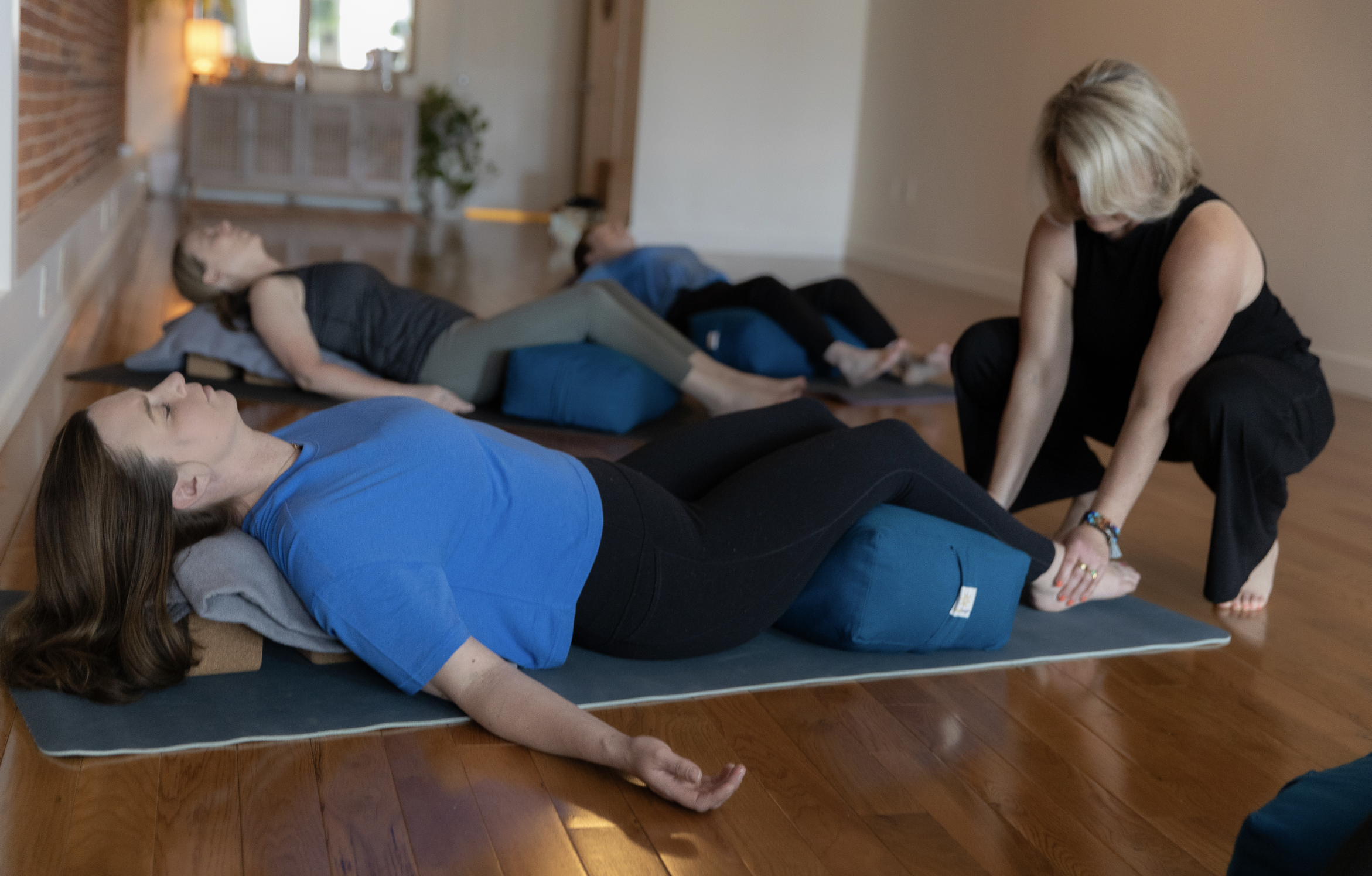
Classes at Sanctuary are organized by nervous system capacity, not performance level. That means you're not sorted into beginner, intermediate, or advanced. You're not here to achieve a pose or keep up with the person next to you. There are no mirrors. No heated room to push through. No culture of performance surrounding the practice, and none of the implicit pressure that comes with it.
Sharon Gordon, the founder, is a Certified Yoga Therapist (C-IAYT), a licensed Physical Therapist Assistant, and has trained extensively at the Himalayan Institute under some of the most respected teachers in the tradition. She brings both clinical understanding of how the nervous system actually works and deep knowledge of how the practice was originally designed to be taught. These are not separate things at Sanctuary. The clinical and the traditional inform each other in every class.
What that means in practice: the pacing, the breath work, the sequencing, the attention to what your nervous system can actually receive on a given day, these are not afterthoughts. They are the point. And the environment, quiet, unheated, unpretentious, and completely uninterested in how any of it looks, is designed to make it possible for your nervous system to finally do what you've been trying to get it to do.
You don't need to perform here. You need to practice. Those are very different things, and the difference is what changes how you actually feel.
If this is what you've been looking for, the schedule is at sanctuaryexeter.com. You can drop in for a single class or reach out with questions. There's no commitment required to find out if the practice fits.